Gases as Solutes
Supporting original reading. Follow the AP topic pathway for reviewed scope, worked reasoning and targeted practice.
Chemistry II · original Chapter 2 · combined Chapter 10
Gallery 2.3.1 Gas Solubility
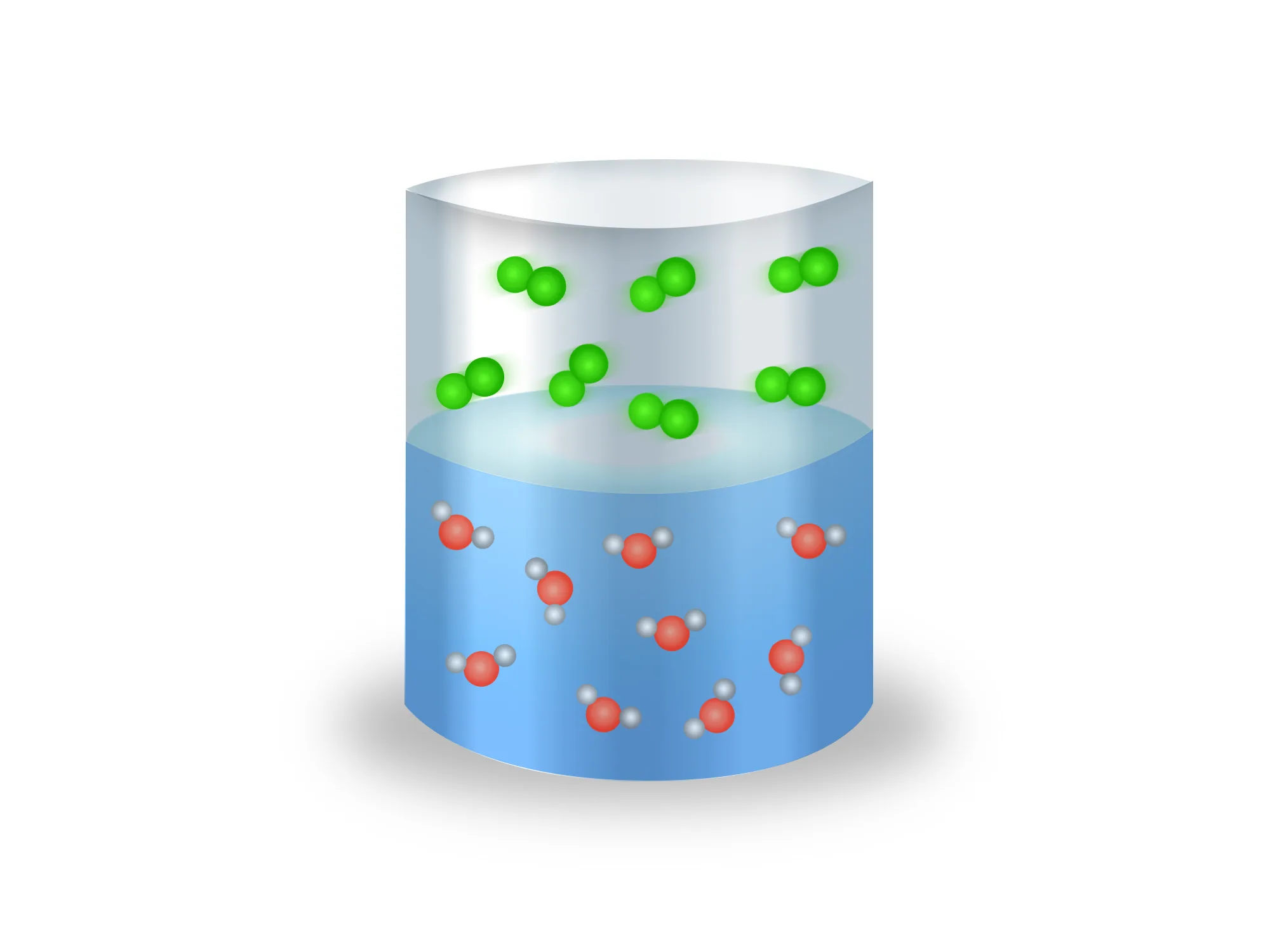
Read all original image captions
Image 1
Image 2
Image 3
Image 4
For many gases, equilibrium solubility in water decreases as temperature rises at fixed gas partial pressure. That is a substance-specific equilibrium trend, distinct from dissolution rate. Many solid solubilities increase with temperature, but this is not universal; use the measured curve or supplied equilibrium model.
For a dilute dissolved gas at equilibrium, Henry’s law relates its concentration to that gas’s partial pressure, with a temperature-dependent coefficient. Raising its partial pressure at fixed temperature often increases its dissolved concentration. The temperature trend is represented by the coefficient and the dissolution thermodynamics; it is not explained simply by subtracting the liquid’s vapor pressure from outside total pressure.
It might be hard to understand how a gas can get into water, but our bodies actually rely upon this process every few seconds. Can you guess why? Here’s a hint: fish rely upon a very similar process to survive.
The simple act of breathing would not be useful to us if not for the solubility of gases, in this case Oxygen. When you breathe, your lungs fill with Oxygen-rich, Carbon-Dioxide-poor air. The alveoli in your lungs are carrying blood that has a lot of carbon dioxide, and when they interact with the air in your lungs, the carbon dioxide dissipates while the Oxygen dissolves into the blood. If gases weren’t soluble, then this process would not work and we would not be able to acquire oxygen by breathing.
If you’ve ever had a fish tank, chances are you needed to have an aerator in there. The typical aerator relies on putting forth a froth of bubbles at the bottom of the tank, allowing them to rise up through the water. During this rise, the gas in the bubbles is dissolving into the water. This process oxygenates the water, allowing the fish to breathe.
Another cool example of gases dissolving in water is in rainwater. When rain condenses in the atmosphere, it begins to grow in size until it becomes heavy enough to fall. When it does fall, it has quite a ways to travel. While is falls, the carbon dioxide in the surrounding air dissolves into the drop. Once carbon dioxide dissolves in water, it becomes acidic. The process is as follows:
Dissolved CO₂ participates in equilibria: CO₂(aq)+H₂O(l)⇌H₂CO₃(aq). Only a fraction is present as the hydrated carbonic-acid species. Write an equilibrium arrow rather than implying every dissolved CO₂ molecule converts completely.
Carbonic acid is a weak acid: H₂CO₃(aq)+H₂O(l)⇌H₃O⁺(aq)+HCO₃⁻(aq). Bicarbonate has charge −1. The equilibrium position depends on the stated conditions; the arrow does not imply complete ionization.
Bicarbonate can undergo a second acid equilibrium: HCO₃⁻(aq)+H₂O(l)⇌H₃O⁺(aq)+CO₃²⁻(aq). Bicarbonate is also capable of accepting a proton. Detailed coupled polyprotic calculations are enrichment; the AP skill here is identifying conjugate species and explaining equilibrium.
By releasing the Hydrogen ion, the carbon dioxide causes the drop to become acidic. This process will be concentrated upon in a future chapter.
Due to the carbon dioxide’s influence, the rainwater is naturally a little acidic. This can become even more acidic if there are other acidic gases present, and this leads to acid rain. More on that in a future chapter.
Okay, okay. You know that gases dissolve in water, and that they can influence us in many different ways, but what actually happens when they dissolve? What kind of processes allow the gas to become more soluble or less soluble? What kind of gases are soluble and what kind aren’t?
Well that’s a long list of questions with a lot of answers to provide. We can start by introducing a quantifiable way of measuring a gas’ solubility. It is called Henry’s Law. It looks like this:
The pA refers to the partial pressure of the gas (A) outside of the solution. The [A] is simply the molar concentration of the gas in solution. The kH is Henry’s Constant, and it provides a link between the two. Henry’s law can be written a multitude of ways, and therefore it is important to look at the units of the Henry’s Constant you are using. Here’s a few examples of Henry’s Constant units and the appropriate equation:
We will be using the first form of Henry’s Law, so all the Henry’s constants you will be using are going to be in L-atm/mol.
Now you might be asking yourself: “So Henry’s Law relies only on the partial pressure of a gas? I thought you said that it is affected by temperature as well?” That is a great question.
In fact, temperature does play a strong role in Henry’s Law. It presents itself in Henry’s Constant. Henry’s Constant is so reliant on temperature it is actually a bit of a misnomer to call it a constant. Henry’s Constant is actually a function of temperature and gas. Typically you will be given the Henry’s Constant at 25ºC, the scientific number for room temperature. That’s about 76ºF, if you were curious.
In order to find the Henry’s constant at any given temperature, you will need to know two things: The Enthalpy of Solvation for the gas () and Henry’s constant at 25ºC. You will also need to convert your desired temperature to Kelvin, as it relies on the absolute temperature. The relationship is as follows:
Henry-law temperature enrichment, using the explicit convention p=kp/cc: ln[kp/c(T)/kp/c(T₀)]=(ΔHdiss/R)(1/T−1/T₀), when the dissolution enthalpy is approximated constant. For an exothermic dissolution ΔHdiss<0. Warming then increases this pressure-per-concentration coefficient and decreases c at fixed p. A coefficient using the reciprocal convention has the opposite temperature sign.
The 298 comes from the fact that the standard Henry’s Constant is given at 25ºC, which is equal to 298K. That is also why the subscript for the Henry’s Constant on the right side of the equation says 298. Remember that you will need to input T in Kelvin for this equation to work.
If the pressure-per-concentration form is written k(T)=k(T₀)exp[−C(1/T−1/T₀)], define C=−ΔHdiss/R, in kelvin. Positive C corresponds to an exothermic dissolution in this convention. State that definition instead of saying C=ΔH/R while placing an extra negative sign into the same equation.
Reviewed enrichment relation: kp/c(T)=kp/c(T₀)exp[−C(1/T−1/T₀)], with C=−ΔHdiss/R and absolute temperatures. It is a supplied model for a defined gas, solvent and temperature range, not a universal prediction at arbitrary pressure or for strongly reacting gas solutions.
| Compound | kH, 298 | C |
|---|---|---|
O2 | 769 | 1700 |
H2 | 1282 | 500 |
N2 | 1660 | 1300 |
NH3 | 0.0169 | 4100 |
NO2 | 83.3 | 2500 |
CO2 | 29.4 | 2400 |
| CO | 1053 | 1300 |
Cl2 | 10.53 | 2100 |
| HCl | 0.0526 | 9000 |
SO2 | 0.833 | 3100 |
| Methane | 714.3 | 1600 |
| Ethane | 526.3 | 2300 |
| Propane | 666.7 | 2700 |
| Butane | 909 | 3100 |
| Benzene | 6.25 | 4100 |
As you can see, the Henry’s constant can vary considerably between gases. If you go back to our equation, we see that a higher Henry’s Constant will correlate to a lower solubility. The most soluble gases in this table, Ammonia, Sulfur Dioxide, and Hydrogen Chloride, all easily affect the pH of water. This reflects the high solubility of acids and bases in water, even for gases. Now it’s time to start using these numbers to solve problems.
Example Problem 2.3.1
What is the solubility of Oxygen from air to water at sea level, if the temperature is 15ºC?
Step 1: Identify the knowns and unknowns
We actually don’t know any of these factors. As we are solving for [O2], we can say that we need to figure out the partial pressure of O2 and the kH first.
Step 2: Determine the Partial Pressure of .
All we know for the partial pressure is that we are looking at air at sea level. We know that air has a pressure of 1atm at sea level, and you should know that air is 21% Oxygen. If you don’t remember that number, you should try to commit it to memory. Also know that Nitrogen composes 78% of air.
With the fraction of Oxygen in air and the total pressure, we can figure out the partial pressure of Oxygen:
Step 3: Identify the .
We know our gas is Oxygen and our temperature is 15ºC. Therefore we can use this equation:
We have the is 769 and is 1700, but we need to find out T in K, as we can’t use 15.
Now we can solve for kH:
Step 4: Solve for .
We now know both and . We can now plug these in to the Henry’s Law equation to solve for the solubility of O2.
Glossary and deeper reading · 15 refreshers
These editorial refreshers supplement the reading. Definitions and examples are added guidance; original source wording and recorded answers remain in their original context.
-
Solute
A solute is a component dispersed in a solvent to form a solution. It need not be a solid, and a solution need not be liquid. For example, carbon dioxide is a gaseous solute in carbonated water.
-
Henry’s law
Henry’s law relates a gas's dissolved concentration to its partial pressure over the solution at fixed temperature in an appropriate dilute model. The proportionality constant depends on the gas, solvent, temperature, and the convention used to write the relation. For example, increasing carbon dioxide's partial pressure can increase its dissolved concentration when the model applies.
-
Solubility
Solubility describes how much of a substance can dissolve in a specified solvent under stated conditions. It depends on the solute, solvent, temperature, and other relevant conditions and is distinct from how fast dissolution occurs. For example, two salts can have different equilibrium solubilities in water at the same temperature.
-
Chemical equilibrium
Chemical equilibrium is a dynamic state in which forward and reverse reaction rates are equal. Macroscopic composition remains constant in a closed system under fixed conditions, but reactant and product concentrations need not be equal. For example, a reversible reaction can reach equilibrium with much more reactant than product.
-
Partial pressure
A gas's partial pressure is the pressure it would exert alone in the mixture's volume at the same temperature. In an ideal mixture, the component partial pressures add to the total pressure. For example, a component with mole fraction 0.20 contributes 0.20 of the total ideal pressure.
-
Dilution
Dilution lowers solute concentration by adding solvent while conserving the solute amount when no reaction or loss occurs. Concentration calculations use the final solution volume rather than simply the volume of solvent added. For example, increasing a solution's volume from 100 to 200 milliliters halves its concentration if its solute amount is unchanged.
-
Weak acid or base
A weak acid or base reacts only partially with water and establishes an equilibrium. Its equilibrium constant describes strength, while analytical concentration describes how much was prepared per volume. For example, acetic acid leaves both acid molecules and its conjugate base in water.
-
Polyprotic acid
A polyprotic acid can donate more than one proton per molecule in successive steps. Each step has its own equilibrium constant, so the protons need not dissociate to the same extent. For example, phosphoric acid can lose three protons through separate equilibria.
-
Ion
An ion is an atom or group of atoms with a net electric charge. Ordinary ion formation changes electron count without changing the element's proton count. For example, a sodium atom losing one electron becomes a sodium ion with charge +1.
-
Molarity
Molarity is the amount of a solute in moles divided by the final solution volume in liters. It describes concentration rather than the total amount of solute. For example, 0.10 mole dissolved to make 0.50 liter of solution gives a molarity of 0.20 mole per liter.
-
Enthalpy
Enthalpy is a state function defined from internal energy, pressure, and volume. At constant pressure with only pressure–volume work, an enthalpy change equals the heat transferred to the system. For example, a negative reaction enthalpy indicates heat release for the written reaction under those conditions.
-
Solvation
Solvation is the interaction of solvent particles with dispersed solute particles. When the solvent is water, the process is called hydration. For example, oriented water molecules form hydration shells around dissolved ions.
-
Exothermic process
An exothermic process transfers heat from the chosen system to its surroundings. Under constant-pressure conditions with only pressure–volume work, its enthalpy change is negative. For example, freezing water releases heat to the surroundings.
-
Solvent
A solvent is the component used as the dissolving medium in a solution. It is often present in the greater amount, though the designation also depends on the mixture's context. For example, water is the solvent in a dilute aqueous sugar solution.
-
pH
pH is the negative base-ten logarithm of hydronium activity. In suitable dilute models, activity is approximated by molar concentration relative to the standard concentration. For example, lowering hydronium concentration by a factor of ten raises pH by one unit.