Acids and Bases together
Supporting original reading. Follow the AP topic pathway for reviewed scope, worked reasoning and targeted practice.
Chemistry II · original Chapter 7 · combined Chapter 15
Section Breakdown
- Combined Solutions
- Titration
- Titration Curves
Section 2
Acids and Bases together
So far, we only been looking at solutions of either acids or bases. When you mix acids and bases, however, you have to account for the effects of each acid on the levels.
As you know that acids and bases have opposite effects on . This means that when you mix an acid and a base, the two can counteract one another’s effect on the . Let’s go through and see what happens in the most basic form, the combination of a strong acid and a strong base.
Reviewed hypothetical 25 °C final-volume concentration model: the added analytical NaOH and HCl amounts correspond to 5.00 M and 4.00 M in the same final volume. Treat activities as ideal. Find pH after neutralization.
H⁺+OH⁻→H₂O consumes 4.00 M equivalents of each. Approximately 1.00 M OH⁻ remains, with Na⁺/Cl⁻ spectators.
Equilibrium [H⁺] is positive: [H⁺]=Kw/[OH⁻]≈10⁻¹⁴ M. The stoichiometric value “no excess acid” is not zero equilibrium hydronium.
pOH≈−log₁₀(1.00)=0.00, so pH≈14.00 using pKw=14.00 at 25 °C. Nonideal concentrated solutions require activities.
This is a pretty high , but it’s actually the of a solution that is . This is true for all solutions that have concentrations of strong acids and bases. Therefore a solution that is and will have a . This is because if you combine the three involved equations we had in that solution, you get a neutralization reaction.
You might see a familiar face present after this neutralization reaction. Table Salt, , is the salt formed by this reaction. In fact, the definition of a salt is an ionic solid formed by and acid-base neutralization reaction.
Another great use of the neutralization reactions is its applications in titrations. A titration is a laboratory procedure in which you add a precise amount of some solution of known concentration to a precise amount of another solution of unknown concentration. The end goal of the procedure is to fully react the two solutions, reaching the equivalence point, the point where the two chemicals are stoichiometrically equal in solution according to their reaction equation.
Leaving it in such generic terms makes that hard to follow, doesn’t it? Let’s go ahead and look at one of the most common titrations: Acid-Base Titration.
As was pointed out previously, acids and bases react with one another in a neutralization reaction. For example:
Equivalence means that titrant and analyte have reacted in the stoichiometric ratio of the balanced equation. For NH₃+H⁺→NH₄⁺ this ratio is 1:1. It does not mean their remaining equilibrium concentrations are equal. The endpoint is the observed signal used to stop a titration and should be close to equivalence.
Typically you can’t perfectly identify the equivalence point, but you can get pretty close. This is why your end point will not quite be the same point as your equivalence point, but it’s pretty close.
So how do we determine the equivalence point of an Acid-Base titration?
If we want to identify the equivalence point, we have to first determine what is going on in the solution. Let’s keep with the Ammonia and Hydrochloric Acid titration. We need to determine which one is the known concentration and which is the unknown.
If you can choose what you are performing a titration with, it’s always easier if the known solution is a strong acid or base. This helps to more easily identify the equivalence point, as you will notice later.
As such, we will declare that in this titration, we know the concentration of the strong Hydrochloric acid and we are trying to determine the concentration of the weak base Ammonia. We will be adding the known to the unknown, therefore our titrant, the solution being added, is Hydrochloric acid. Our other player is Ammonia, which is acting as our analyte.
So what is going to happen as we add Hydrochloric acid to an Ammonia solution?
Well, we know that before we add any acid, a solution of ammonia is a weak base, so our will be elevated. As it is a weak base, it means that the Ammonia will exist as both Ammonia and the Ammonium Ion (). The relevant reaction is:
Once we start adding a source of from , this reaction changes to become a neutralization reaction:
The increased also reacts with the Hydroxide ion generated from the base to form water:
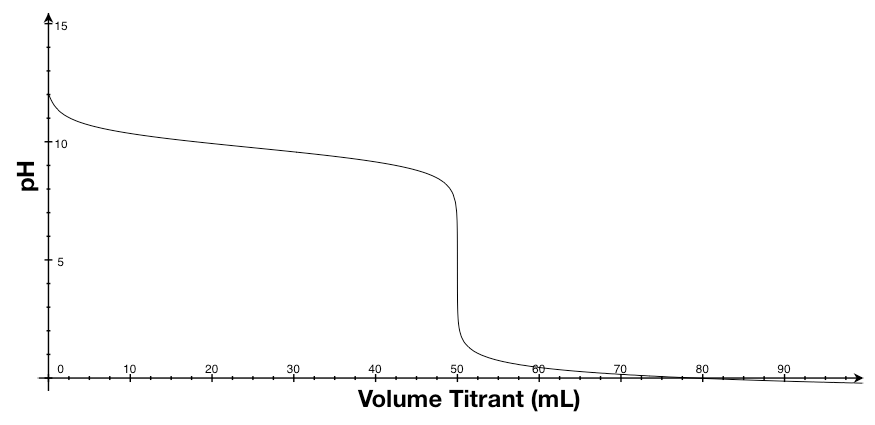
Interactive 7.2.1 Titration Curve
Read all original figure notes
Starting pH
As this curve is a titration of a weak base, the pH before adding any acid is high.
Equivalence Point
Once all the base has reacted, the pH drops really quickly as more acid is added.
Gallery 7.2.1 — Eight specified ideal titration examples
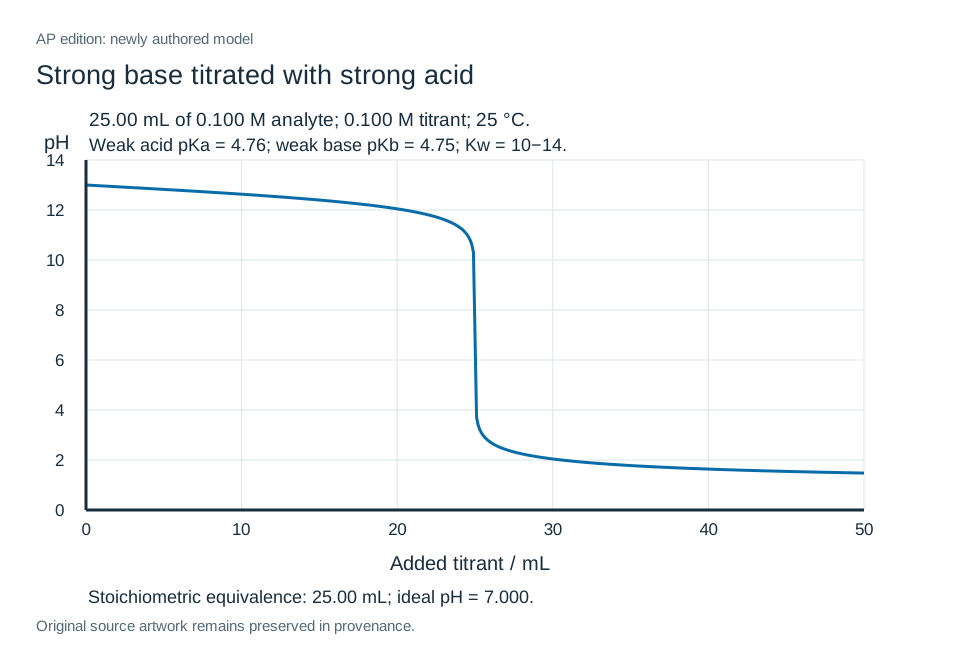
AP edition authored model. Quantitative stipulated ideal monoprotic titration, solved from mass and charge balance. Eight specified ideal examples do not exhaust all possible titration curves. Full charge/mass balance generates these examples; weak/weak examples are retained enrichment rather than a required quantitative AP calculation.
Read all reviewed image captions
Image 1
AP edition authored model. Quantitative stipulated ideal monoprotic titration, solved from mass and charge balance. Eight specified ideal examples do not exhaust all possible titration curves. Full charge/mass balance generates these examples; weak/weak examples are retained enrichment rather than a required quantitative AP calculation.
Image 2
AP edition authored model. Quantitative stipulated ideal monoprotic titration, solved from mass and charge balance. Eight specified ideal examples do not exhaust all possible titration curves. Full charge/mass balance generates these examples; weak/weak examples are retained enrichment rather than a required quantitative AP calculation.
Image 3
AP edition authored model. Quantitative stipulated ideal monoprotic titration, solved from mass and charge balance. Eight specified ideal examples do not exhaust all possible titration curves. Full charge/mass balance generates these examples; weak/weak examples are retained enrichment rather than a required quantitative AP calculation.
Image 4
AP edition authored model. Quantitative stipulated ideal monoprotic titration, solved from mass and charge balance. Eight specified ideal examples do not exhaust all possible titration curves. Full charge/mass balance generates these examples; weak/weak examples are retained enrichment rather than a required quantitative AP calculation.
Image 5
AP edition authored model. Quantitative stipulated ideal monoprotic titration, solved from mass and charge balance. Eight specified ideal examples do not exhaust all possible titration curves. Full charge/mass balance generates these examples; weak/weak examples are retained enrichment rather than a required quantitative AP calculation.
Image 6
AP edition authored model. Quantitative stipulated ideal monoprotic titration, solved from mass and charge balance. Eight specified ideal examples do not exhaust all possible titration curves. Full charge/mass balance generates these examples; weak/weak examples are retained enrichment rather than a required quantitative AP calculation.
Image 7
AP edition authored model. Quantitative stipulated ideal monoprotic titration, solved from mass and charge balance. Eight specified ideal examples do not exhaust all possible titration curves. Full charge/mass balance generates these examples; weak/weak examples are retained enrichment rather than a required quantitative AP calculation.
Image 8
AP edition authored model. Quantitative stipulated ideal monoprotic titration, solved from mass and charge balance. Eight specified ideal examples do not exhaust all possible titration curves. Full charge/mass balance generates these examples; weak/weak examples are retained enrichment rather than a required quantitative AP calculation.
Now as we add the , it will slowly decrease the until there is no more base left to neutralize. From that point on, as is a strong acid, it will quickly drop the , as it is simply adding to the solution. Therefore, we can identify the equivalence point as the point where the begins to drop considerably faster.
Now, if we keep going, eventually the will start approaching the of the titrant itself, but as it has been diluted, it won’t quite reach there. Therefore, if we draw up a graph of the as a function of the volume of titrant added, it would have a shape something like the graph in Interactive 7.2.1.
This particular example curve is distinct from other titration curves, as it begins with a high and tends towards a very low . This is because it is the curve of a titration of a weak base with a strong acid. If you look at the titration curves that result from other situations, they look a bit different. Those examples are shown in Gallery 7.2.1.
The general point of a titration is to identify the sharp drop-off or climb in that occurs around the equivalence point. As you track whilst adding your titrant, you should see a sharp change in occur after a certain amount, that quickly slows. That jump means you have reached your equivalence point.
Read the equivalence volume from the titration curve and use the balanced reaction to calculate the original analyte amount. Equal moles apply to a 1:1 reaction; other coefficients require a corresponding mole ratio.
For a A+b B→products, equivalence satisfies n(A)/a=n(B)/b.
For solutions, C(A)V(A)/a=C(B)V(B)/b. The familiar CtitrantVtitrant=CanalyteVanalyte applies only to a 1:1 stoichiometric reaction.
On the titration curve, we identify the equivalence point as the middle of the jump that appears. The above relations only hold true at that point. From that point, you can read , and you should already know and . Using these values, you can find the concentration of the analyte.
Interactive 7.2.2 Titration Curve Example Problem 7.2.1

Read all original figure notes
Example Problem 7.2.1:
You are titrating 750mL of an acetic acid solution with 10M Potassium Hydroxide. The titration curve is shown below. What is the concentration of acetic acid?
Step 1: Identify the equivalence point.
As we can see, the increases significantly after the addition of about 20mL of the . Therefore, the equivalence point occurs after 20mL of titrant addition.
Step 2: Using the equivalence equation, solve for the concentration of the Acetic Acid?
It doesn’t matter what units you use for volume, so long as you keep it consistent.
Example Problem 7.2.2:
What volume of 4M is needed to completely neutralize 800mL of 15M ? What is the of the neutralized solution?
n(HCl)=15.0×0.800=12.0 mol. HCl+NaOH→NaCl+H₂O is 1:1, so 12.0 mol NaOH is required.
V(NaOH)=12.0/4.00=3.00 L=3000 mL. In M·mL units, 15.0×800=12000, not 1200; the retained 300 mL result is superseded.
At ideal strong-acid/strong-base equivalence at 25 °C, [H₃O⁺]=[OH⁻] and pH=7.00. Neutral pH depends on temperature and activities.
Glossary and deeper reading · 14 refreshers
These editorial refreshers supplement the reading. Definitions and examples are added guidance; original source wording and recorded answers remain in their original context.
-
Titration
Titration measures an analyte by its reaction with a measured amount of another reagent. The balanced reaction and the observed endpoint must be connected to the equivalence condition. For example, an acid's amount can be inferred from a measured volume of a base with known concentration.
-
Strong acid or base
A strong acid transfers protons essentially completely to water in the applicable aqueous-solution model. A dissolved strong hydroxide base dissociates into its constituent ions and supplies hydroxide; it does not have to react with water to generate that hydroxide. Strength is distinct from concentration and, for a solid base, from how much can dissolve. For example, dissolved sodium hydroxide supplies sodium and hydroxide ions even when the prepared solution is dilute.
-
pH
pH is the negative base-ten logarithm of hydronium activity. In suitable dilute models, activity is approximated by molar concentration relative to the standard concentration. For example, lowering hydronium concentration by a factor of ten raises pH by one unit.
-
Stoichiometry
Stoichiometry uses a balanced chemical equation to relate amounts of reactants and products. Equation coefficients provide mole ratios rather than direct mass ratios. For example, forming water from hydrogen and oxygen consumes two moles of hydrogen molecules per mole of oxygen molecules.
-
Hydronium
Hydronium is the H₃O⁺ ion used in the introductory model of proton behavior in water. Aqueous H⁺ notation is shorthand for a solvated proton rather than a bare proton moving independently in the liquid. For example, a Brønsted acid can transfer a proton to water and form hydronium.
-
pOH
pOH is the negative base-ten logarithm of hydroxide activity. At a specified temperature, pH plus pOH equals the corresponding pKw, which is approximately 14 at 25 °C. For example, increasing hydroxide activity tenfold lowers pOH by one unit.
-
Equivalence point
The equivalence point is the condition where titrant and analyte have reacted in the balanced equation's stoichiometric ratio. Its pH depends on the species remaining and is not always seven. For example, a weak-acid–strong-base titration has a basic equivalence-point solution under the usual model.
-
Titrant
A titrant is the reagent added in measured amounts during a titration. Its concentration and reaction stoichiometry connect the delivered volume to the analyte amount. For example, a standardized base solution can be the titrant for an unknown acid.
-
Analyte
An analyte is the substance being identified or measured in an analysis. Its amount or concentration is the target of the measurement rather than necessarily the largest component of the sample. For example, an unknown acid is the analyte in an acid–base titration.
-
Titration endpoint
A titration endpoint is the observed signal used to stop or interpret a titration. It approximates the equivalence point but can differ because of the chosen indicator or measurement conditions. For example, an indicator's persistent color change may mark an endpoint near the steep region of a titration curve.
-
Weak acid or base
A weak acid or base reacts only partially with water and establishes an equilibrium. Its equilibrium constant describes strength, while analytical concentration describes how much was prepared per volume. For example, acetic acid leaves both acid molecules and its conjugate base in water.
-
Ion
An ion is an atom or group of atoms with a net electric charge. Ordinary ion formation changes electron count without changing the element's proton count. For example, a sodium atom losing one electron becomes a sodium ion with charge +1.
-
Dilution
Dilution lowers solute concentration by adding solvent while conserving the solute amount when no reaction or loss occurs. Concentration calculations use the final solution volume rather than simply the volume of solvent added. For example, increasing a solution's volume from 100 to 200 milliliters halves its concentration if its solute amount is unchanged.
-
Mole
A mole is an amount of substance containing exactly 6.02214076 × 10²³ specified entities. The entities can be atoms, molecules, ions, or formula units, so the counted entity must be named. For example, one mole of oxygen molecules contains two moles of oxygen atoms.