Intermolecular Forces
Supporting original reading. Follow the AP topic pathway for reviewed scope, worked reasoning and targeted practice.
Chemistry I · original Chapter 6 · combined Chapter 6
Section breakdown
- What are Intermolecular Forces?
- Dipole-Dipole
- Hydrogen Bonding
- London Dispersion Forces
Section 3
Intermolecular Forces
What are Intermolecular Forces?
Remember that atoms can bond and form stable units called molecules through the sharing of electrons known as intramolecular (within the molecule) bonding. Up to this point, we have learned a lot about different types of bonding and also different states of matter (solids liquids and gases). Thus, it is very important for us to tie things together from what we’ve learned so far.
In combination with atomic theory, it is important to consider the interactions between the molecules that are formed. These interactions between molecules are what are known as intermolecular forces, or the forces felt between each molecule rather than the bonds. These are important for it is the main reason how some states are formed.
Keep in mind that when substances change state from solid to liquid or liquid to gas, the molecules still stay intact. The difference lies within the interactions between each molecule. In this section, the three main intermolecular forces that are most common between molecules are : London Dispersion Forces, Dipole-Dipole Forces, and Hydrogen Bonding.
Dipole-Dipole
A polar covalent bond shares electrons unequally, giving partial charges. It is not simply an ionic bond. A molecule can have polar bonds yet no net molecular dipole if their vectors cancel; CO₂ is a familiar example. Intermolecular comparisons need the resulting molecular structure, not just an element-pair electronegativity difference.
Interactive 1.5 Multiple Dipoles

Read all original figure notes
Interaction of multiple dipoles
Interactive 1.4: Dipole Moment
Read all original figure notes
Dipole Formation
There is a positive side and a negative side.
Dipole Interaction
Positive side and negative side of each molecule are attracted to each other.
But how does this look when there are a bunch of dipole molecules floating around together in a condensed form, such as water? Well the Figure on the nest page should clear things up. In this state, the molecules will rearrange themselves accordingly to achieve the optimal amount of attractions while minimizing repulsions.
Hydrogen Bonding
Interactive 1.6: 3D Rendering of water molecules
Here shows the interaction between three water molecules in 3D space. The small size accounts for the molecules being able to condense together.

The source placement has no attached COLLADA geometry.
Gallery 1.4: London Dispersion Forces
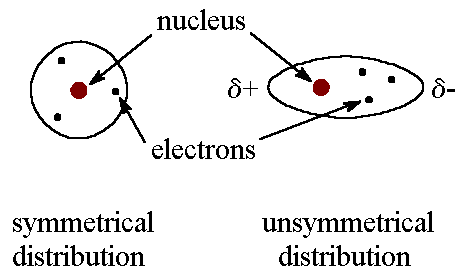
Notice how the electrons rearrange themselves to move towards one side forming an instantaneous dipole
Read all original image captions
Image 1
Notice how the electrons rearrange themselves to move towards one side forming an instantaneous dipole
Image 2
The instantaneous dipole of one molecule will induce a dipole in another nonpolar molecule causing attraction.
London dispersion attractions occur between all atoms and molecules, including polar molecules. They arise from correlated fluctuations in electron density and grow with polarizability and close contact. For a nonpolar molecular substance they are often the only intermolecular attraction in our standard model; for a polar one they coexist with other attractions.
Gallery 1.5: Drawings of Each Molecule
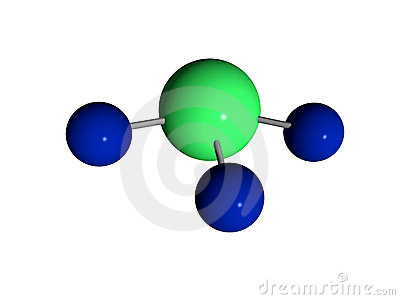
An NH3 molecule interacting with another NH3 molecule (put two of the same molecules next to each other)
Read all original image captions
Image 1
An NH3 molecule interacting with another NH3 molecule (put two of the same molecules next to each other)
Image 2
Long carbon chain of C6H14, therefore large molar mass.
Image 3
Two potassium bromide molecules (find what one looks like to work off of)
Use the fluctuating-electron-density model for dispersion, rather than imagining electrons that stop moving and then create a dipole. Quantum electron density and correlated fluctuations provide the underlying description. The simple instantaneous-dipole sketch is a model of those correlations, not a literal movie of classical electron paths.
Example Problem 6.3.1
For pureNH₃,pureC₆H₁₄and solidKBr, identify the particles and major attractions. Explain which examples are molecular and why solidKBr needs an ionic-lattice description.
- NH3
- C6H14
- KBr
It is first very important to think about each molecule and see what the molecules will look like. This example will have a long solution so pay attention!
Glossary and deeper reading · 10 refreshers
These editorial refreshers supplement the reading. Definitions and examples are added guidance; original source wording and recorded answers remain in their original context.
-
Intermolecular force
Intermolecular forces are interactions between molecules. They affect properties such as boiling point and solubility and are distinct from the bonds within each molecule. For example, vaporizing water separates molecules while largely preserving their O–H bonds.
-
Dipole–dipole forces
Dipole–dipole forces involve interactions between permanent molecular dipoles. Favorable orientations place relatively positive and negative regions near one another. For example, neighboring hydrogen chloride molecules can attract through their permanent dipoles.
-
Hydrogen bond
Hydrogen bonding is a directional interaction involving hydrogen bonded to a sufficiently electronegative atom and an appropriate electron-rich acceptor. In the introductory model, N, O, and F commonly provide the relevant partners. For example, water molecules hydrogen bond when one molecule's O–H group interacts with another molecule's oxygen lone pair.
-
London dispersion forces
London dispersion forces arise from fluctuating electron distributions and the dipoles they induce in neighboring particles. They occur between all atoms and molecules, including nonpolar ones. For example, dispersion attracts neighboring argon atoms even though they have no permanent molecular dipoles.
-
Covalent bond
A covalent bond involves shared electron density between atoms. The sharing can be approximately equal or unequal depending on the atoms and their environment. For example, the bond in a hydrogen molecule shares electrons between two identical atoms.
-
Partial charge
A partial charge describes an uneven distribution of electron density within a bond or molecule. It is marked by a delta symbol and does not necessarily represent a full ionic charge. For example, oxygen carries a partial negative charge in water while its hydrogens carry partial positive charges.
-
Electronegativity
Electronegativity describes an atom's tendency to attract shared electron density in a bond. It helps predict bond polarity but is not the same as ionization energy or electron affinity. For example, oxygen attracts shared electrons more strongly than hydrogen in an O–H bond.
-
Molecular polarity
Molecular polarity concerns a molecule's overall separation of charge. Both bond polarity and molecular geometry determine whether individual bond dipoles cancel. For example, carbon dioxide has polar bonds but is nonpolar overall because its linear bond dipoles cancel.
-
Polarizability
Polarizability describes how readily a particle's electron distribution can be distorted. Larger, more diffuse electron clouds are often more polarizable, strengthening dispersion interactions when other factors are comparable. For example, iodine is more polarizable than fluorine.
-
Condensation
Condensation is a phase change from gas to liquid. It releases energy to the surroundings as particles form more closely associated liquid arrangements. For example, water vapor condensing on a cooler surface forms liquid droplets.