Non-standard Cells
Supporting original reading. Follow the AP topic pathway for reviewed scope, worked reasoning and targeted practice.
Chemistry II · original Chapter 8 · combined Chapter 16
Section Breakdown
Section 3
Non-standard Cells
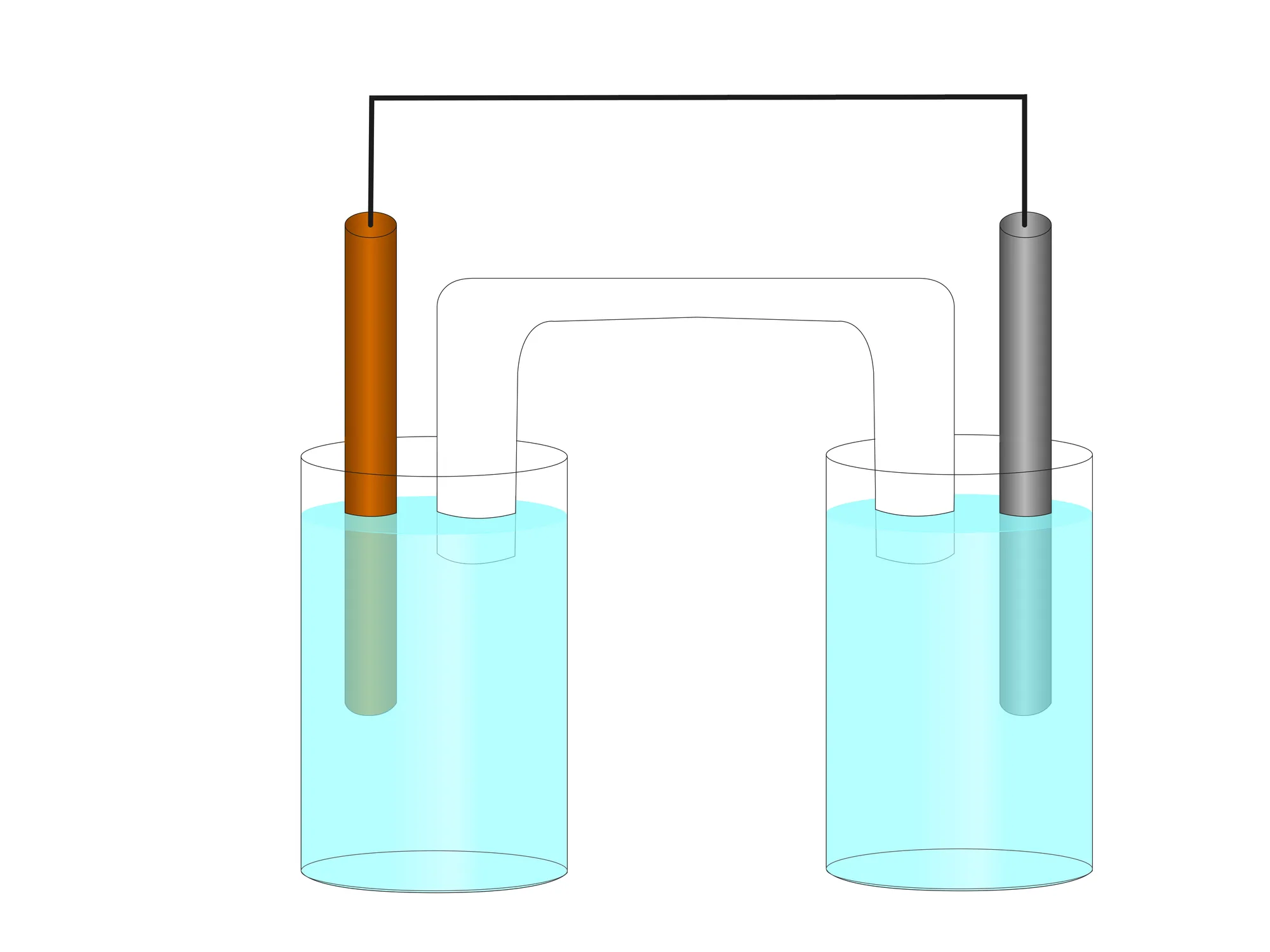
So far we have only covered the galvanic cell under standard conditions. A galvanic cell is actually a subset of electrochemical cells. An electrochemical cell is any combination of two half-cells. A galvanic cell has the requirement that it create a voltage difference that results from a redox reaction.
The other type of electrochemical cell, the electrolytic cell, doesn’t produce electricity. Instead, this type of cell utilized electricity to drive a reaction. In essence, it is the opposite of the galvanic cell.
An electrolytic cell typically does not have the anode and cathode directly connected by a conductive medium. Instead, a voltage is applied by hooking each side up to a battery or other voltage source. The current that battery puts out is used to fuel the redox reaction of the cell.
Typically, these cells are used to decompose chemicals, commonly water. In some cases, galvanic cells can be reversed by applying a voltage opposing the one created, a concept used in rechargeable batteries, as will be explored later.
For the electrolysis of water, the cells are:
For an overall reaction of:
Now that reaction has a . This means that the Gibb’s free energy will be positive, indicating a non-favorable reaction. For this reason, the application of a voltage across the anode and cathode is needed to produce a reaction.
With the ability to determine the potential of electrochemical cells under standard conditions, we need a way of converting them to non-standard conditions. In order to do so, we will use the Nernst Equation, given as:
Gallery 8.3.1 Electrochemical Cells
Read all original image captions
Image 1
Image 2
Image 3
If we assume that the temperature will remain at , we can simplify that equation down to:
This approach can apply to both a half-reaction and a complete cell. The only difference between the two is that in a half-reaction, disregard the ‘concentration’ of electrons whilst calculating . For example, in the half reaction for copper, , which has a standard potential of , we would determine as:
Assuming .
This means that the effectiveness of the cell relies on the concentration of the copper ion in solution. In fact, the concentration can greatly affect the performance of an electrolytic cell.
Example Problem 8.3.1
What is the potential of a galvanic cell made up of a copper electrode in a solution of copper sulfate, and a zinc electrode in zinc sulfate which is kept at ?
Step 1: Write out equation and find .
Galvanic cell implies a positive cell potential, so we know that the electrode with a lower will be getting oxidized. In our cell, the half-reactions are:
This means that zinc will be getting oxidized, and we already have equal numbers of electrons involved in each reaction.
Therefore our reaction is:
From our half-reactions we see that .
Step 2: Determine .
For this reaction, our reaction coefficient is found by:
Step 3: Determine
From our reaction, we can find .
Now we know everything we need for . As we are not at , we have to use the full equation:
Example Problem 8.3.1
Reviewed replacement: use an explicitly ideal aqueous Zn/Cu galvanic cell at 298.15 K, with a(Zn²⁺)=0.100, a(Cu²⁺)=0.0100, E°cell=1.100 V, R=8.31446 J mol⁻¹ K⁻¹ and F=96485.3 C mol⁻¹. Calculate E and ΔG for Zn(s)+Cu²⁺(aq)→Zn²⁺(aq)+Cu(s). This replaces the incomplete calcium/chloride electrolysis calculation.
The balanced half-reactions are Zn→Zn²⁺+2 e⁻ at the anode and Cu²⁺+2 e⁻→Cu at the cathode. The net reaction transfers n=2 moles of electrons per written reaction.
Pure-metal activities are one. Q=a(Zn²⁺)/a(Cu²⁺)=0.100/0.0100=10.0.
E=E°−RT ln Q/(nF)=1.100−(8.31446×298.15)/(2×96485.3) ln(10)=1.07042 V.
ΔG=−nFE=−2×96485.3×1.07042=−206559 J≈−206.56 kJ per written reaction. Use E rather than E° because the prompt requests current nonstandard conditions.
The original source does not specify a physically adequate calcium/chloride electrolysis model. Calcium cannot simply be deposited from ordinary aqueous CaCl₂ without considering water reduction; a molten/non-aqueous production model needs appropriate data. The reviewed Zn/Cu task has its own explicit conditions and answer.
Glossary and deeper reading · 10 refreshers
These editorial refreshers supplement the reading. Definitions and examples are added guidance; original source wording and recorded answers remain in their original context.
-
Electrochemical cell
An electrochemical cell separates oxidation and reduction into electrode processes. A galvanic cell delivers electrical energy from a favored reaction, while an electrolytic cell uses supplied electrical energy to drive an unfavored direction. For example, a zinc–copper galvanic model transfers electrons through the external wire while ions carry charge through the solutions.
-
Nernst equation
The Nernst equation relates a cell's potential to temperature and the reaction quotient for its written reaction. It distinguishes the current composition-dependent potential from the standard reference potential. For example, approaching chemical equilibrium brings the ideal cell's actual potential toward zero.
-
Redox reaction
A redox reaction combines oxidation of one species with reduction of another. Electron loss and gain must balance in the net equation along with atoms and total charge. For example, zinc reducing copper ions involves zinc oxidation and copper-ion reduction.
-
Anode
The anode is the electrode where oxidation occurs. This definition applies to both galvanic and electrolytic cells. For example, a zinc electrode releasing zinc ions and electrons is an anode in the zinc–copper galvanic model.
-
Cathode
The cathode is the electrode where reduction occurs. It may deposit metal or host another reduction without necessarily gaining mass. For example, a copper electrode receiving electrons that reduce dissolved copper ions is a cathode.
-
Electrolysis
Electrolysis uses an external electrical source to drive an electrode reaction in an otherwise unfavorable direction. The products depend on the specified half-reactions and medium, including possible competition from water. For example, reduction of metal ions at a cathode can produce an electroplated metal layer.
-
Gibbs free energy
Gibbs free energy combines enthalpy and entropy contributions to a system at specified temperature and pressure. For a reaction at constant temperature and pressure, a negative actual reaction free-energy change favors its forward direction, while standard and actual values must be distinguished. For example, a favorable reaction can still be slow if its pathway has a large activation barrier.
Read more: Gibbs Free Energy and Thermodynamic Favorability →
-
Mole
A mole is an amount of substance containing exactly 6.02214076 × 10²³ specified entities. The entities can be atoms, molecules, ions, or formula units, so the counted entity must be named. For example, one mole of oxygen molecules contains two moles of oxygen atoms.
-
Half-reaction
A half-reaction describes either the oxidation or reduction part of a redox process. It includes electrons explicitly so that charge and electron transfer can be balanced. For example, zinc forming a zinc ion and two electrons is an oxidation half-reaction.
-
Ion
An ion is an atom or group of atoms with a net electric charge. Ordinary ion formation changes electron count without changing the element's proton count. For example, a sodium atom losing one electron becomes a sodium ion with charge +1.