Effects of Solutes on Water
Supporting original reading. Follow the AP topic pathway for reviewed scope, worked reasoning and targeted practice.
Chemistry II · original Chapter 2 · combined Chapter 10
Section Outline
- Salt Effect
- Common-Ion effect
- Freezing Point Depression
- Boiling Point Elevation
Section 2
Effects of Solutes on Water
Just knowing how compounds dissolve in water doesn’t really tell you that much practical information. This section will cover what you might expect to see happen as a result of water containing a solute, or perhaps many solutes.
Aqueous means dissolved in water. Water solvates ions or molecules according to their charge distribution and intermolecular interactions; the solute need not have started as a solid. Dissolving a salt can separate its lattice ions, while dissolving a molecular substance can disperse intact molecules. State the species instead of calling every solute a molecule.
You have covered that different molecules have differing solubilities, but all those solubilities are for a pure solution. That is, a solution of only water and that compound. What happens, then, when you have multiple compounds dissolved in water?
Adding another dissolved salt can change an equilibrium, but not because water molecules are simply used up. In a concentration model, a common ion changes the reaction quotient and can reduce the dissolution of a sparingly soluble salt. A spectator electrolyte that supplies no common ion can change activities through ionic-strength effects; that is a distinct, more advanced issue. Do not infer a universal decrease from any arbitrary added salt.
Ionic strength weights each dissolved ion’s concentration by the square of its charge. It helps describe how interactions change activities, rather than providing a universal “more ions means less soluble” rule. Under some conditions an inert electrolyte can increase molar solubility. For AP concentration calculations, state the ideal approximation and analyze common-ion mass action separately.
Ionic strength actually goes past just the number of ions, and it also looks at the charge on the ions. Therefore, higher charges result in higher Ionic Strengths. The formula for determining Ionic Strength is as follows:
The ci refers to the ion’s concentration, and the zi refers to the ion’s charge number (the absolute value of the charge). The summation function just shows that you add up the effects of all the ions in the water, for N ions.
Keep two effects separate. A common ion alters the concentration quotient in the simple Ksp model. A salt without a common ion can alter activity coefficients, and the direction is not determined merely by counting total ions. Quantitative activity corrections are enrichment; the required AP task is to explain and calculate the stated ideal common-ion equilibrium.
Gallery 2.2.1 Salt Effect
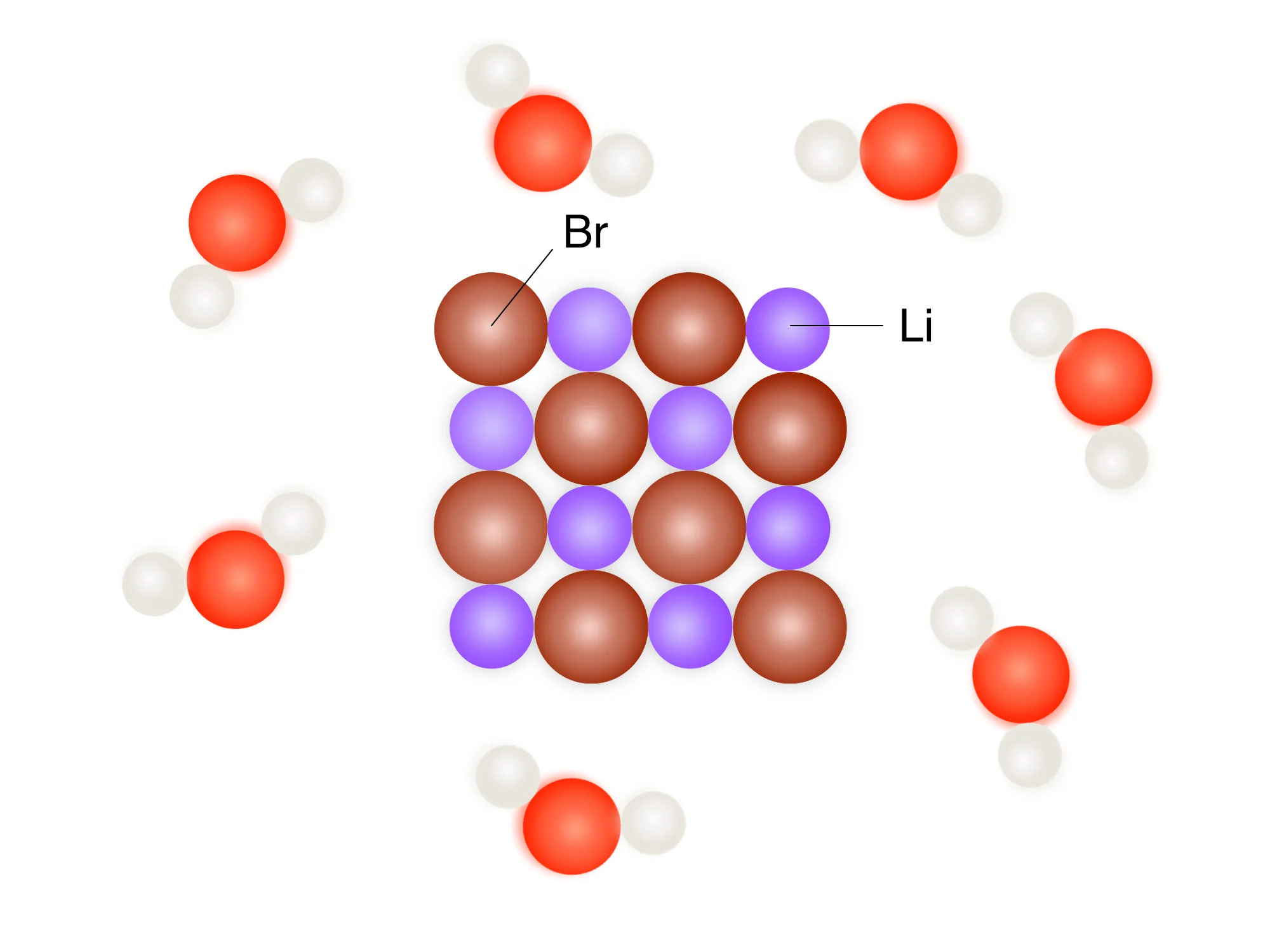
Read all original image captions
Image 1
Image 2
Reviewed enrichment calculation: compare the formal ionic strengths of (a) 1.00 M NaCl plus 0.750 M Mg(NO₃)₂ and (b) 2.00 M KOH, assuming complete dissociation and stated final concentrations. This asks only for ionic strength, not a solubility ranking. Neither solution by itself specifies enough chemical equilibrium information to rank the solubility of the original incorrectly written copper sulfate.
The salt effect isn’t the only way a compound’s solubility can be affected. There’s one more major effect known as the common ion effect. This occurs when you have two compounds in a solution which both contain the same ion. One example would be if you were to dissolve NaCl in a solution of CuCl. Both Compounds contain Chlorine, therefore you should see the common ion effect.
The common ion effect serves to lower the solubility of a compound depending on the concentration of the ion already present in the solution.The reason this happens stems from Le Chatelier’s Principle. To figure out why, let’s look at the aforementioned case.
For a clear common-ion example, compare NaCl(aq), which supplies Cl⁻, with sparingly soluble CuCl(s), copper(I) chloride. Cupric chloride means copper(II) chloride, CuCl₂, and is a different formula. The common-ion calculation must identify the correct salt and oxidation state.
If you imagine a solution of just NaCl, you notice that it contains water, Na+ and Cl-. Now if you were to add in some CuCl, it would also dissolve. However, there is already some Cl- in the solution. This means that the equilibrium of that dissolution equation will be pushed towards the CuCl(s) side, meaning that the solubility will decrease.
For a sparingly soluble salt, a balanced dissolution equation and itsKsp can connect ion concentrations to saturation under stated conditions. For AaBb(s)⇌aA(aq)+bB(aq), the powers inKsp are the stoichiometric coefficientsaandb. They are not defined simply as the ion charge numbers. Identify the actual ion formulas, charge balance and any initial common-ion concentration before calculating a molar solubility.
For a sparingly soluble salt AaBb(s)⇌a A(aq)+b B(aq), the ideal concentration expression is Ksp=[A]a[B]b. The exponents are the balanced stoichiometric coefficients, not automatically the charge numbers. Specify the ion charges in the balanced dissolution equation and omit the pure solid.
In this formula, and are the concentrations at saturation for the salt.
The dissolved ion concentrations are equal only for a 1:1 salt in a solution that has no other sources of those ions. For CaF₂, dissolving s mol L⁻¹ supplies [Ca²⁺]=s and [F⁻]=2s in the simple model. With a common ion already present, add its initial concentration to the stoichiometrically produced amount.
Reviewed common-ion replacement: find the molar solubility of AgCl at a temperature where Ksp=1.80×10⁻¹⁰ in 0.0100 M NaCl. Assume complete NaCl dissociation, ideal concentrations, unchanged final volume and no other silver complexes. Then s(0.0100+s)=Ksp; because s≪0.0100, s≈1.80×10⁻⁸ M.
One other topic we have yet to cover is the effect that solutes have on the boiling point and freezing point of their solvent. You might be surprised to know that while water has a boiling point of 100ºC, salt water has a boiling point above 100ºC. How far above depends on how salty the water is. A simple relationship exists for the calculation of the boiling point elevation and freezing point depression.
In these equations, b refers to the molality of the salt and i refers to the number of ions in the salt. If you don’t remember, molality is the moles of the salt per the mass of water (in kg). The KB and KF values refer to constants of the solvent. For water, KB is 0.512 and KF is 1.853. Both have units of . It might be useful to remember that water has a density of 1kg/L.
The original 50%-by-mass NaOH colligative calculation is superseded as a real-solution prediction. Dilute ideal freezing/boiling relations cannot be applied quantitatively at that loading without major nonideality and phase information. Colligative properties and molality are beyond required AP coverage. A defensible enrichment exercise must supply a dilute model, solute amount, solvent mass and an effective van’t Hoff factor with its assumptions.
Glossary and deeper reading · 19 refreshers
These editorial refreshers supplement the reading. Definitions and examples are added guidance; original source wording and recorded answers remain in their original context.
-
Common-ion effect
The common-ion effect is an equilibrium response caused by adding a species already present in the relevant equilibrium. In the simple dissolution model, adding a shared ion lowers the amount of solid that can dissolve at fixed temperature. For example, added chloride can reduce silver chloride's solubility when other reactions are negligible.
-
Colligative property
Colligative properties depend chiefly on the number of dispersed solute particles in an appropriate dilute-solution model. Familiar examples include boiling-point elevation and freezing-point depression. For example, an ideally dissociated salt can affect freezing temperature more than the same molal amount of a nondissociating solute, though real concentrated solutions require additional care.
-
Solute
A solute is a component dispersed in a solvent to form a solution. It need not be a solid, and a solution need not be liquid. For example, carbon dioxide is a gaseous solute in carbonated water.
-
Aqueous solution
An aqueous solution is a solution in which water is the solvent. The dissolved substance may originate as a solid, liquid, or gas, so aqueous does not mean that a solid has melted. For example, sodium chloride dissolved in water is aqueous even though the pure salt is solid.
-
Ion
An ion is an atom or group of atoms with a net electric charge. Ordinary ion formation changes electron count without changing the element's proton count. For example, a sodium atom losing one electron becomes a sodium ion with charge +1.
-
Solubility
Solubility describes how much of a substance can dissolve in a specified solvent under stated conditions. It depends on the solute, solvent, temperature, and other relevant conditions and is distinct from how fast dissolution occurs. For example, two salts can have different equilibrium solubilities in water at the same temperature.
-
Chemical equilibrium
Chemical equilibrium is a dynamic state in which forward and reverse reaction rates are equal. Macroscopic composition remains constant in a closed system under fixed conditions, but reactant and product concentrations need not be equal. For example, a reversible reaction can reach equilibrium with much more reactant than product.
-
Reaction quotient
The reaction quotient describes a mixture's current composition using the equilibrium-expression form. It uses species activities, approximated by concentrations or partial pressures in suitable models, with powers from balanced coefficients. For example, a quotient below the equilibrium constant favors net forward reaction toward equilibrium.
-
Ionic strength
Ionic strength summarizes dissolved-ion concentrations with weighting by the square of each ion's charge number. It helps describe deviations between ionic activities and concentrations. For example, at equal concentration a divalent ion contributes more to ionic strength than a monovalent ion.
-
Electrolyte
An electrolyte forms mobile ions when dissolved and can allow a solution to conduct electric current. Strong and weak electrolytes differ in the extent to which dissolved species form ions under the stated conditions. For example, dissolved sodium chloride supplies sodium and chloride ions to water.
-
Solubility product
A solubility product is an equilibrium constant for a specified dissolution reaction. Its expression includes dissolved-species activities and omits the pure solid. For example, dissolving one formula unit that releases two anions gives an anion activity squared in the expression.
-
Le Châtelier’s principle
Le Châtelier’s principle predicts the qualitative response when a system initially at equilibrium is disturbed. A justified explanation distinguishes the immediate disturbance from the subsequent reaction toward a new equilibrium. For example, adding a reactant can favor its net consumption, while temperature changes can also alter the equilibrium constant.
-
Oxidation number
An oxidation number is a formal electron-accounting value assigned using specified rules. Changes in oxidation number help identify oxidation and reduction but are not always actual atomic charges. For example, oxygen usually has oxidation number −2 in water while hydrogen has +1.
-
Saturated solution
A saturated solution has the dissolved concentration corresponding to equilibrium with the undissolved phase under the stated conditions. Microscopic dissolution and precipitation can continue at equal rates when the solid is present. For example, additional solid may remain undissolved after a saturated salt solution is reached at fixed temperature.
-
Stoichiometry
Stoichiometry uses a balanced chemical equation to relate amounts of reactants and products. Equation coefficients provide mole ratios rather than direct mass ratios. For example, forming water from hydrogen and oxygen consumes two moles of hydrogen molecules per mole of oxygen molecules.
-
Solvent
A solvent is the component used as the dissolving medium in a solution. It is often present in the greater amount, though the designation also depends on the mixture's context. For example, water is the solvent in a dilute aqueous sugar solution.
-
Molality
Molality is the amount of solute in moles divided by the solvent mass in kilograms. It uses solvent mass rather than solution volume and differs from molarity. For example, one mole of solute dissolved in two kilograms of water has molality 0.50 mole per kilogram.
-
Mole
A mole is an amount of substance containing exactly 6.02214076 × 10²³ specified entities. The entities can be atoms, molecules, ions, or formula units, so the counted entity must be named. For example, one mole of oxygen molecules contains two moles of oxygen atoms.
-
Dilution
Dilution lowers solute concentration by adding solvent while conserving the solute amount when no reaction or loss occurs. Concentration calculations use the final solution volume rather than simply the volume of solvent added. For example, increasing a solution's volume from 100 to 200 milliliters halves its concentration if its solute amount is unchanged.