Earlier Kinetics Questions Draft
Earlier draft appendix. It is not part of the AP pathway, and its answers have not been checked. Study the AP course →
This separate seventeen-problem draft overlaps the selected Kinetics chapter. Original wording, differing quantities, and formula PDF attachments are preserved here. These are earlier versions of existing problems, not seventeen additional primary problems. No answers are supplied.
Chapter Problems
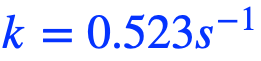
- A reaction proceeds with a rate constant of
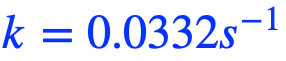 . What order is the reaction?
- You add two reactants to water to have them react. You track the concentration of one of the reactants over time. Using the following data, predict the half-life of the reactant in solution (from the initial concentration):
- Going off of the same data from number two, what is the time that will need to pass for the concentration of the reactant to reach 0.23M?
- You add 10mg of Baking Soda (NaHCO3) to a 10M solution of Vinegar (CH3COOH). They react in a second order fashion to produce Carbon Dioxide gas. If the system is at 1atm and 25ºC, how much gas is produced after 5 minutes have passed? The reaction is:

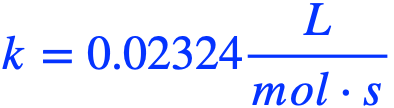
- Using the following set of graphs, determine the rate constant (including units) for the reaction:
- A reaction has a Pre-Exponential factor of 4.31
 and an Activation energy of 422
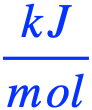 . What is the half-life of the reaction if a reactant starts at 4M and is at 45ºC?
- When Sodium Chloride dissolves in warm water, it has a rate constant of 0.32
 . You add 4mol of NaCl to 10L of water, resulting in a negligible increase in volume. How long will it take for the NaCl to be below detection limit for your instrument, if your instrument can detect down to 5mg NaCl/kg Water?
- You track the dissolution rates of an unknown salt at varying temperatures. The salt dissolves in a first-order reaction, and the graphs of
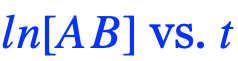 are shown below. Determine the Arrhenius constants for the reaction.
- Three reactions progress simultaneously. The reactions and their rate coefficients are:



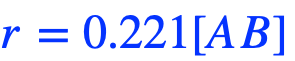


Determine an expression for the rate of depletion of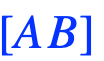 ?
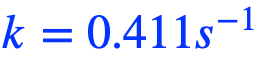
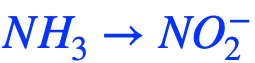
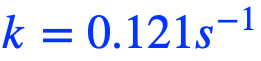
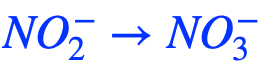
- Atmospheric Nitrogen is converted into Nitrate through various biological reactions. If each reaction is first order and has generic equations as shown below, determine which step is the limiting reaction as well as the half-life of
 in this reaction chain.
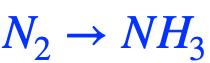
- You have two beakers that contain a single chemical, A. This chemical reacts with a second chemical, B, in a second order fashion (first-order in each A and B). You heat one of the beakers to 35ºC, leaving the other at 20ºC. You then add chemical B to each beaker, making the concentrations of A and B both 10M. If this reaction has a pre-exponential factor of
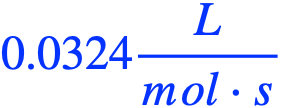 , determine how much faster the warmed beaker will reach a concentration of 3M in A.
- You have a two-reactant reaction that reacts in a second-order relationship. It is first-order in each reactant. If you hold one reactant constant at 10M, and the reaction’s rate coefficient is
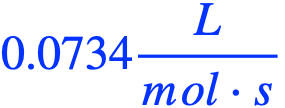 , what is the half-life of the second reactant?
- Two reactions proceed simultaneously in a beaker, each is first-order in chemical A. You believe that a third reaction is occurring between the chemicals that is also depleting A. If the rate constants for the two reactions are
 , and the concentration of A over time is shown below, what order is the last reaction?
- A salt precipitation reaction is occurring between two monovalent ions:
 . If this reaction has a rate coefficient of
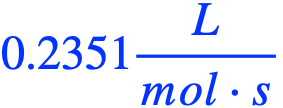 , and you are increasing the temperature of the solution at a rate of 5ºC/min, when will the solution boil if the starting conditions were a temperature of 35ºC, and
 ? Ignore the effects of temperature on the rate constant.
- The reaction of iron and oxygen to form rust occurs in a pseudo-first order form, as the oxygen concentration is typically constant over time. If the rate constant is
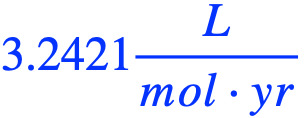 , how long will it take for 24% of an iron object to rust?
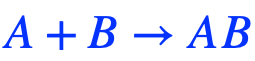
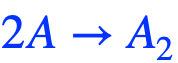
- Two competing reactions use the same reactant. The reactions and rate equations are shown below. How long will it take for 95% of the reactant to be used up, and how much of each product is formed?

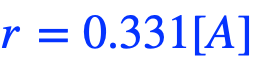
- If the following two reactions proceed sequentially, how long will it take for the first reaction to become the rate limiting reaction? Initially,
 .